
A Swedish Easter, the start of Holy Week
The symbols, the food, the traditions, starting on Palm Sunday.
-
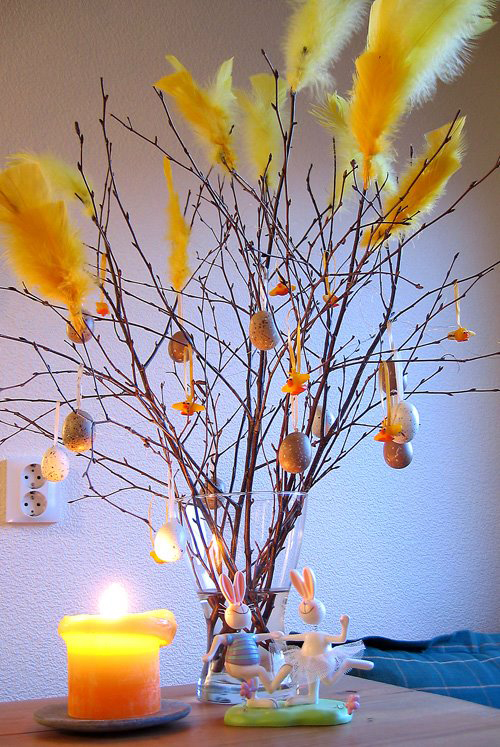 The colorful påskris can be seen in most Swedish homes during Easter.
 -
-
Easter in Swedish is called “påsk” and comes from the Hebrew word “pesah” meaning passing. Easter and its preceding holy days have a unique history in Sweden - www.nordstjernan.com/news/traditions/6318/ It is a decidedly yellow season. The yellow color has nothing to do with the liturgical colors for Easter, which are black, white and violet. No, Easter's yellow comes from the fact that many of the symbols we have for Easter seem to be yellow (as opposed to Christmas for instance, which is red): the feathers, the daffodils and the chickens on the Easter cards. Still checking all of the numbers but 1,500 tons herring, 2,000 tons of eggs and SEK 1.5 billion on flowers ... Easter, is in Sweden a serious holiday for sure. Keep track of things Swedish, in Sweden and in the U.S. by subscribing to The Swedish Newspaper in America - www.nordstjernan.com/subscribe (Become part of a growing Swedish American family. Nordstjernan, doorway to a Sweder life; fun, food, trivia, traditions and current events.)
-
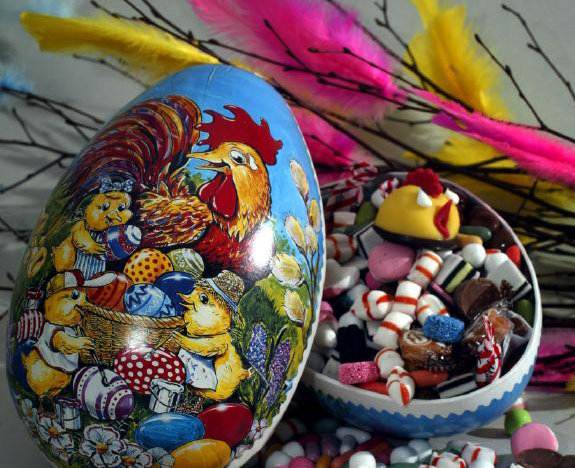 Swedish children don't have egg hunts or an Easter bunny, but they do have påskägg (Easter eggs) stuffed with candy. Bildbyrån photo
 -
-
Påskägget
The Easter egg (påskägget) is a paper or plastic egg with pictures of chickens on it, which gets filled with candy and is given to children. Since Swedes don’t have an Easter Bunny in their celebration, these eggs are very important to children. But the egg is also the main Easter symbol in that it embodies the message of death and resurrection. The egg’s shell is a symbol of the grave, and what it contains is a symbol of new life, the chicken growing inside eventually opens its own grave and walks out. How to create beautiful Easter eggs - www.nordstjernan.com/news/traditions/4417/ -
 Life made Sweder ... News, fun, trivia and features from Sweden and Sweden in America. And a gift that will last for a long time: SUBSCRIBE to Nordstjernan Whether for yourself or someone you love, it will last for as long as you'd like...
 -
Påskris
The colorful twigs with feathers (påskris) that you see everywhere in Sweden at this time of year, has less jolly implications. Bound by birch twigs, the påskris was in the 17th century used for Long Friday’s flagellation. Today you buy it at the local market and tie colorful feathers to it. You can also decorate your påskris with blown out eggs that you dye yourself, or you can buy plastic eggs. Roosters, hens, chickens and witches are also used to decorate not only the påskris but your house as well.
Påskkärringar
The “påskkärring” or “påskakärring,” is an old tradition that has its roots in the activities of Maundy Thursday. According to folklore, all the world’s bad spirits were let lose the instant Judas Iscariot betrayed Jesus. During the 17th century the belief in the devil created witch hunts, and women (mostly) were executed for having participated in the banquet of the devil on Maundy Thursday. Where did it all take place? On the island of Blåkulla (also known as Blå Jungfrun) situated in the Kalmar Strait of the Baltic Sea. The witches flew there on brooms. Swedish children dress up like påskkärringar complete with grandma’s dress, apron and a kerchief tied under the chin, they paint rosy cheeks and freckles on their faces and therefore don’t much resemble the American picture of a witch. A påskkärring also carries a broom, an old-fashioned coffee pot and a basket, and walks around the neighborhood, Halloween-style, giving out drawings in exchange for candy. When this tradition began is hard to tell, it seems it started in western Sweden some time in the beginning of the 1800’s. -
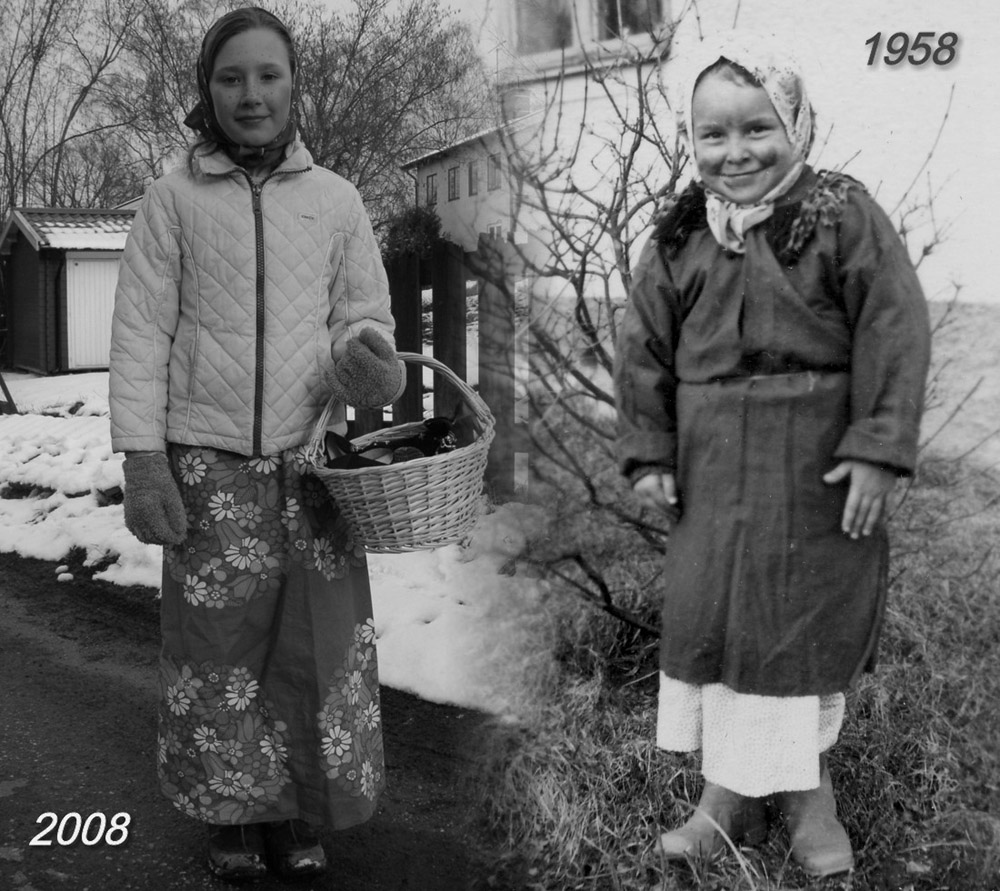 Påskkärringar then ...
 -
Food for Easter
Each region or “landskap” in Sweden has its own traditions when it comes to what to eat for Easter, but most of the dishes include eggs, lamb and salmon. Unlike the food we eat for Christmas, Easter food is much lighter and almost always includes marzipan and candy-filled Easter eggs for dessert. There’s also the “påskbord” (Easter smorgasbord) with eggs, pickled herrings, salmon and Jansson’s temptation. Here's a brief with links to some of the more common dishes for the Easter table: Swedish Food; gravlax, herring.. “Påskmust” is also sold in stores; it’s the same soft drink as “julmust.” -
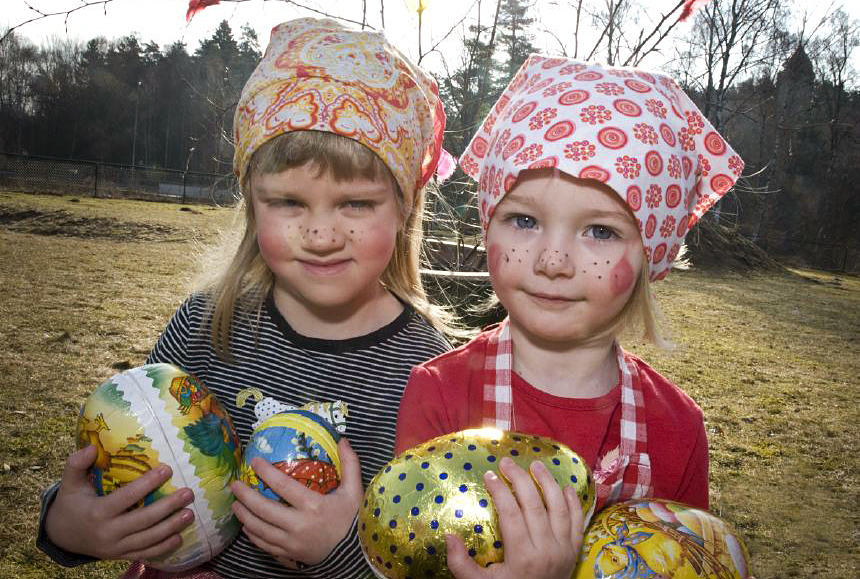 ... and now. They don't really look like they're on their way to meet the devil on the isle of Blå Jungfrun, do they? Bildbyrån photo
 -
Marzipan egg recipe
Making eggs out of marzipan isn’t that difficult. All you need is basic marzipan.
Ingredients for Basic Marzipan
2 cups sugar
1/8 teaspoon cream of tartar
4 cups ground almonds (or almond flour)
2 egg whites
powdered sugar for dusting -
 Ulf Kirchdorfer's book, "Swede Among the Rednecks" - available at “Amazon”
 -
1. Prepare a workspace by sprinkling powdered sugar over a marble slab, wooden cutting board or large baking sheet. Fill your sink or a large bowl with cold water.
2. Place the sugar and 2/3 cup water in a large heavy saucepan and heat gently, stirring, until the sugar dissolves.
3. Add the cream of tartar and turn up the heat. Bring to a boil and cover, boiling for 3 minutes.
4. Uncover and boil until the temperature reaches soft-ball stage, 240 degrees on a candy thermometer.
5. Place the bottom of the saucepan in the cold water you’ve prepared, stirring the sugar mixture constantly until it becomes thick and creamy.
6. Stir in the ground almonds and the egg whites, then place back over low heat and stir for 2 minutes more until the mixture is thick.
7. Spoon the marzipan onto your prepared work surface, and turn it with a metal spatula until it cools down enough to touch.
8. Coat your hands in powdered sugar and begin to knead the marzipan, working it until it is smooth and pliant.
9. Your marzipan can be used immediately or stored by wrapping it in plastic wrap and keeping it in an airtight container. -
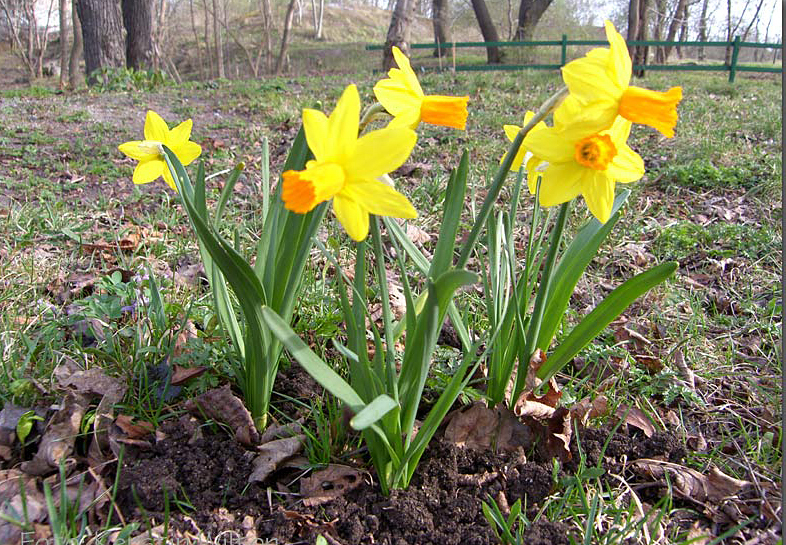 Yellow is the color of Swedish Påsk because most of our Easter symbols are yellow, like the daffodil, in Swedish called påsklilja.
 -
Now that you have marzipan you can make påskägg (Easter eggs) or other figures with a little bit of yellow food dye and baking chocolate (approximately 100 g). Melt the chocolate. Just use a few drops of the food dye. Shape little eggs of the marzipan, then dip in melted chocolate. Let cool in the fridge.
-
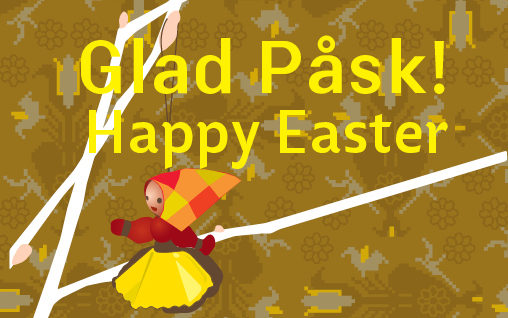 Illustration for Sweden & America, spring 2002 by Flat.
 -
-
-